Contact
Jim Now
Contact
Jim Now

This is one of my favorite tools for discussing serious problems with management. It is simply a side-by-side comparison of the assumptions we make about a given situation, and the realities of that situation in the words of victims, employees, critics and those indirectly affected.

Featured in the January edition of Minnesota PRSA Perspectives Blog
When giving opinions to senior management some middle managers and most front-line workers tend to give advice without thinking about how to craft it so that decision-makers will be receptive to it. That can doom a good idea to oblivion.

This is the time of year when senior public relations practitioners are nominated for election to the Public Relations Society of America (PRSA) College of Fellows. As I begin my 23rd year as a PRSA Fellow (I’m also an International Association of Business Communicators (IABC) Fellow), it’s interesting to reflect on the experiences of all those I have coached and mentored over the years, on my way to becoming a Fellow in both organizations. Just about everyone comes to the Fellow’s process with few clues about what a Fellow actually is.

Stop the production of critics and enemies. Once you victimize them, they have far more power than you’ll ever have; they live forever, will survive you and will be waiting in the swamp.

Tripping points are the ingredients of trouble, those decisions, actions or instigation steps in the process smart people initiate or allow themselves to undergo to get in to trouble. I guarantee you’ll recognize every one of them, especially if you listened to your mom growing up.
Tripping Point #1: Looking for Trouble

One thing about crisis management and leadership in difficult situations has remained the same throughout my career and that is the glacial speed at which litigation unfolds. Understand that my clients are always defendants (perpetrators). In today’s Facebook, Twitter, Snapchat and “the new social media app being introduced next week” age, there are dramatic new pressures on lawyers, defendants and perpetrators to get more explained and done faster.

Wells Fargo took another meaningless step to avoiding their clear responsibility to clean up the mess they created, involving hundreds of thousands (perhaps even more now) of their customers. They separated the chairman and CEO posts, a gesture which is simply beyond understanding. It reflects again, their misguided focus on fixing operations without paying the price of fraud, deceit and despicable behavior toward their customers.

Tim Sloan, the former president and chief operating officer of Wells Fargo, now the new CEO and member of the bank’s board of directors, assures us that the cover-up continues. “You should expect more tough headlines, as additional accountability actions occur and other investigations and reviews are completed,” he said. But efforts to actually remedy the thousands, perhaps millions, of customer-facing problems Wells Fargo has caused, and is likely still causing, are stalled. Many may never really be resolved.
The First and Most Important Axiom of Crisis Survival:
Neither the media, your toughest opponents, smartest critics, nor the government knows enough to defeat you. Defeat is almost always the work of uninformed or over confident, overly optimistic bosses, co-workers and associates; well-meaning but uninformed friends, relatives, or from dysfunction in an organization.
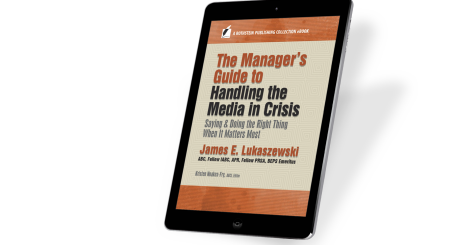
When you’re in trouble, attracting media attention is surprisingly easy – you just don’t want it to be the wrong kind! If an event causes the phone to ring and TV cameras to appear in your lobby, you need confidence that the people who happen to be at your worksite that day are prepared. Not a problem if everyone – executives, PR, managers, and employees – is familiar with Jim Lukaszewski’s sure-fire methods for handling the media.
Read The Manager’s Guide to Handling the Media in Crisis: Saying & Doing the Right Thing When It Matters Most now.
 Sign Up For My Free Monthly Newsletter